
How HR Professionals Can Reduce Time-to-Hire Without Compromising Quality
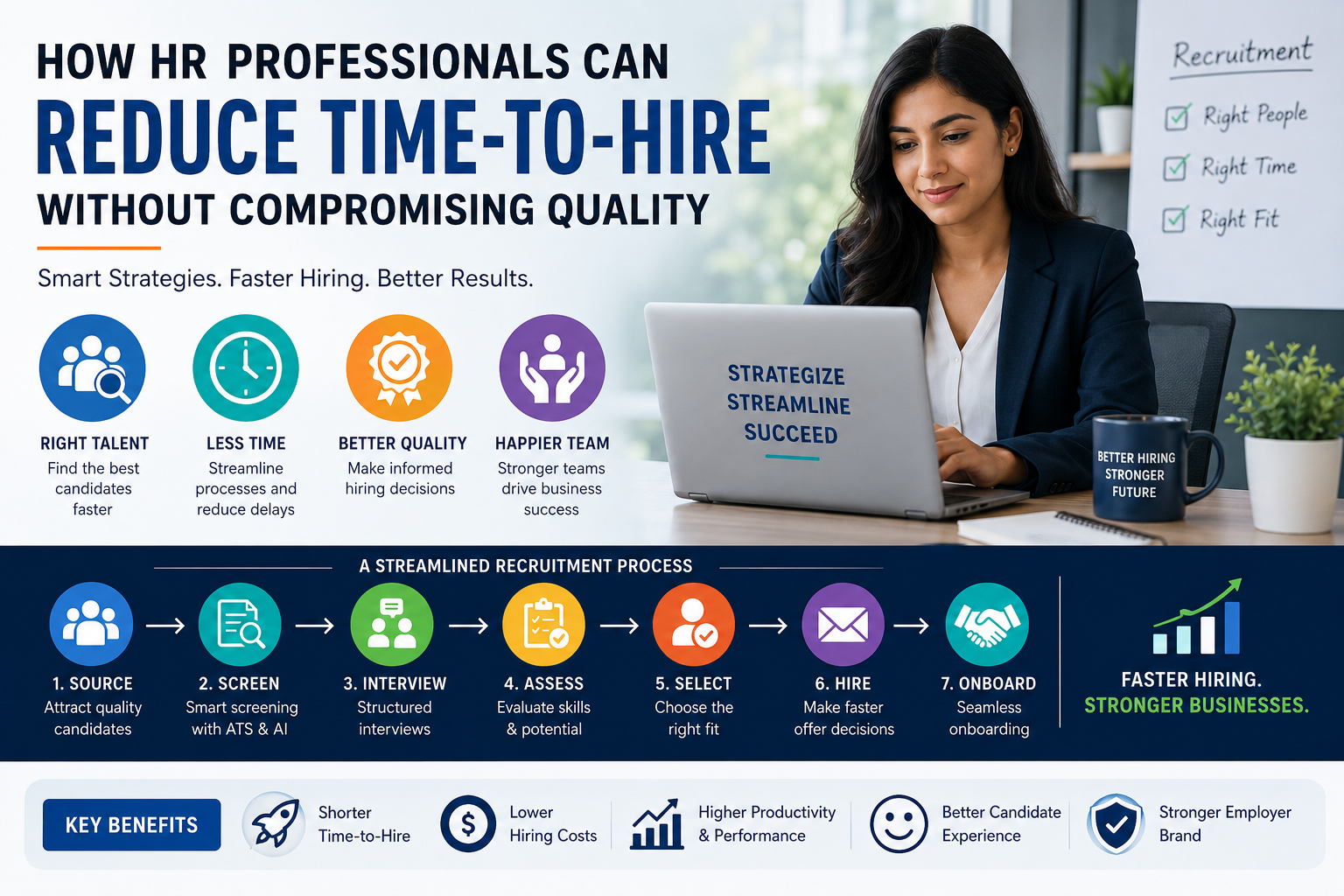
How HR Professionals Can Reduce Time-to-Hire Without Compromising Quality
Introduction
Hiring the right candidate is important, but hiring efficiently is equally important. A long recruitment process can result in losing qualified candidates to competitors, increasing hiring costs, and putting additional pressure on existing employees.
For HR professionals, the goal should not simply be to hire faster. The real objective is to reduce unnecessary delays while maintaining hiring quality.
A well-designed recruitment process can help organizations identify suitable candidates faster, improve candidate experience, and build stronger teams.
What Is Time-to-Hire?
Time-to-hire measures how long it takes to move a candidate through the recruitment process, generally from the candidate entering the hiring pipeline until accepting the job offer.
It can be affected by:
- Resume screening
- Interview scheduling
- Hiring manager availability
- Candidate assessments
- Internal approvals
- Salary negotiations
- Background verification
- Offer processing
Understanding where delays occur is the first step toward improving the hiring process.
Why Reducing Time-to-Hire Matters
A lengthy hiring process can create several problems for an organization.
1. Top Candidates May Accept Other Offers
Highly qualified candidates often have multiple opportunities. If your organization takes too long to make a decision, another employer may hire the candidate first.
2. Recruitment Costs Increase
The longer a position remains open, the more time recruiters and hiring managers spend sourcing and evaluating candidates.
3. Productivity Can Decline
When a position remains vacant, existing employees may have to take on additional responsibilities.
4. Candidate Experience Suffers
Candidates expect clear communication and reasonable timelines. Delays can create a negative impression of the employer.
5. Business Growth Can Slow Down
For critical roles, hiring delays can directly affect projects, operations, sales, and business expansion.
7 Strategies to Reduce Time-to-Hire
1. Create a Clear Job Description
A poorly written job description can attract a large number of unsuitable applications.
Before publishing a vacancy, clearly define:
- Job responsibilities
- Required qualifications
- Essential skills
- Preferred skills
- Experience requirements
- Location
- Reporting structure
- Compensation range where appropriate
The clearer the requirements, the easier it becomes for recruiters to identify suitable candidates.
2. Build a Talent Pipeline Before You Need It
One of the biggest recruitment mistakes is starting candidate sourcing only after a vacancy becomes urgent.
HR teams should continuously build talent pipelines for frequently required positions.
Talent pools can include:
- Previous applicants
- Employee referrals
- Passive candidates
- LinkedIn connections
- Campus candidates
- Recruitment agency databases
- Professional communities
When a vacancy opens, recruiters can immediately approach relevant candidates instead of starting from zero.
3. Use Technology for Resume Screening
Manual resume screening can become extremely time-consuming when hundreds or thousands of applications are received.
Applicant Tracking Systems and AI-powered recruitment tools can help HR teams:
- Parse resumes
- Identify relevant skills
- Match candidates with job requirements
- Filter candidates based on experience
- Detect duplicate applications
- Organize candidate information
Technology should support recruiters rather than replace human decision-making.
4. Standardize the Interview Process
Unstructured interviews often create unnecessary delays.
Create a standard interview framework for each position that includes:
- Core interview questions
- Technical assessment criteria
- Behavioral competencies
- Evaluation scorecards
- Required interview stages
- Final decision criteria
A structured process allows interviewers to evaluate candidates consistently and make decisions faster.
5. Improve Interview Scheduling
Interview scheduling is one of the most common sources of recruitment delays.
Instead of exchanging multiple emails or messages, HR teams can use scheduling tools that allow candidates and interviewers to select suitable time slots.
For urgent positions, consider:
Resume Screening → HR Interview → Technical Interview → Final Interview → Offer
Avoid unnecessary interview rounds that do not add meaningful value.
6. Set Hiring SLAs
Recruitment becomes much faster when everyone understands their responsibility.
For example:
Recruitment StageSuggested TargetResume screening1–2 daysHR interview1–3 daysTechnical assessment2–3 daysFinal interview1–3 daysOffer approval1–2 days
These timelines can be adjusted according to the organization's hiring requirements.
The important point is to establish accountability at every stage.
7. Make Faster Hiring Decisions
Recruitment teams should establish a clear decision-making process.
After an interview, interviewers should submit feedback promptly rather than waiting several days.
A simple evaluation framework can include:
- Technical skills
- Relevant experience
- Communication
- Problem-solving
- Cultural alignment
- Salary expectations
- Availability
This gives hiring managers a consistent framework for making decisions.
The Role of HR in Faster Hiring
Recruiters should act as process owners, not simply resume collectors.
HR professionals can improve hiring efficiency by:
- Understanding business requirements
- Working closely with hiring managers
- Maintaining candidate pipelines
- Tracking recruitment metrics
- Improving communication
- Automating repetitive tasks
- Reviewing recruitment bottlenecks
- Maintaining a positive candidate experience
The best recruitment teams combine speed, structure, technology, and human judgment.
Recruitment Metrics HR Professionals Should Monitor
To improve hiring speed, HR teams need measurable data.
Important metrics include:
Time-to-Hire
Measures how long it takes to hire a candidate.
Time-to-Fill
Measures how long a position remains open before being filled.
Offer Acceptance Rate
Shows how many candidates accept offers compared with the number of offers made.
Interview-to-Offer Ratio
Helps determine whether the screening process is producing suitable candidates.
Source of Hire
Identifies which recruitment channels produce the best candidates.
Quality of Hire
Measures whether new employees perform successfully after joining.
Reducing time-to-hire should never come at the expense of quality of hire.
How AI Is Changing Recruitment
Artificial intelligence is increasingly being used to automate repetitive recruitment activities.
AI-powered recruitment systems can assist with:
- Resume parsing
- Candidate-job matching
- Skill extraction
- Candidate ranking
- Interview scheduling
- Candidate communication
- Recruitment analytics
However, HR professionals should ensure that technology is used responsibly.
AI should support objective decision-making while keeping appropriate human oversight throughout the recruitment process.
Candidate Experience Still Matters
Speed alone does not create a good recruitment process.
Candidates also want:
- Clear job information
- Timely communication
- Transparent expectations
- Professional interviews
- Feedback where possible
- Clear information about the next steps
Even candidates who are not selected can become future applicants, customers, or advocates for your employer brand.
A Simple Recruitment Workflow
A streamlined recruitment process can look like this:
Workforce Requirement
↓
Job Description
↓
Candidate Sourcing
↓
AI/ATS Resume Screening
↓
HR Screening
↓
Technical/Functional Assessment
↓
Interview
↓
Final Selection
↓
Offer
↓
Background Verification
↓
Onboarding
The objective is to remove unnecessary steps while maintaining proper evaluation and compliance.
Final Thoughts
Reducing time-to-hire is not about rushing recruiters or skipping important hiring steps. It is about removing unnecessary friction from the recruitment process.
HR professionals can achieve faster hiring by combining clear job requirements, talent pipelines, recruitment technology, structured interviews, defined hiring timelines, and data-driven decision-making.
Ultimately, successful recruitment should deliver three things:
The right candidate.
At the right time.
For the right role.
When recruitment becomes faster, structured, and candidate-focused, organizations can build stronger teams while improving both business performance and candidate experience.