
How to Improve Candidate Experience: 10 Strategies for HR Professionals
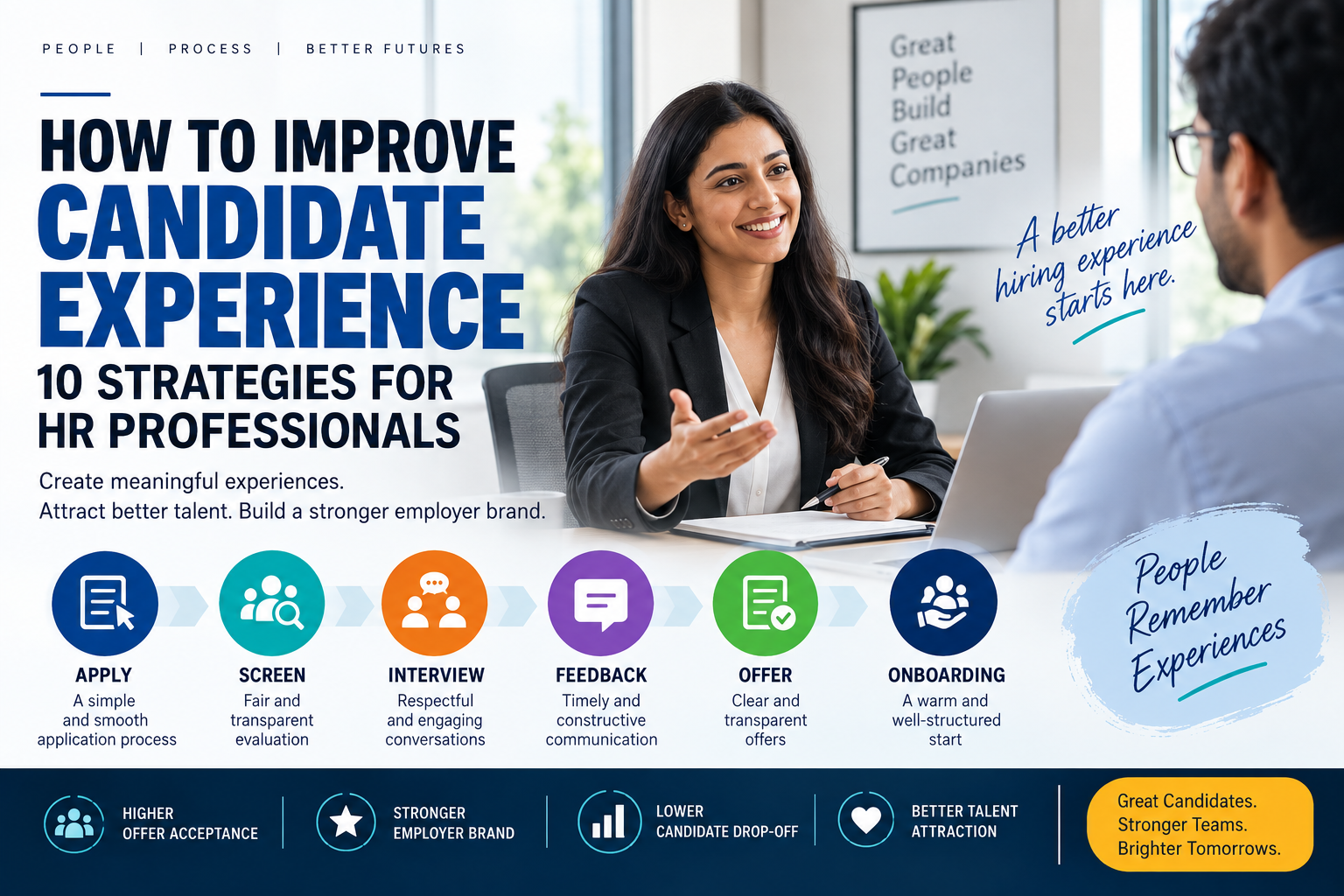
How to Improve Candidate Experience: 10 Strategies for HR Professionals
Introduction
Recruitment is not only about finding the right candidate. It is also about creating the right experience throughout the hiring journey.
Every interaction a candidate has with an organization—from seeing a job advertisement to receiving an interview invitation, completing an assessment, or receiving an offer—shapes their perception of the company.
A smooth and professional candidate experience can help organizations attract better talent, increase offer acceptance rates, strengthen their employer brand, and build long-term trust.
For HR professionals, candidate experience should therefore be treated as an essential part of the overall talent acquisition strategy.
What Is Candidate Experience?
Candidate experience refers to how job applicants perceive and interact with an organization throughout the recruitment process.
It includes every stage of the candidate journey:
Job Search → Application → Screening → Interview → Assessment → Selection → Offer → Onboarding
At each stage, candidates form an opinion about the organization.
A candidate may be highly qualified, but if the recruitment process is confusing, slow, or poorly communicated, they may decide not to continue.
Why Candidate Experience Matters
Candidate experience directly affects recruitment outcomes.
1. Better Employer Brand
Candidates often share their recruitment experiences with colleagues, friends, and online communities. A professional hiring process can strengthen your company's reputation as an employer.
2. Higher Offer Acceptance
Candidates who receive timely communication and a positive interview experience are more likely to feel confident about joining the organization.
3. Lower Candidate Drop-Off
A complicated application process or long periods without communication can cause candidates to leave the recruitment process.
4. Better Talent Attraction
A strong reputation can make it easier to attract qualified candidates for future vacancies.
5. Stronger Employee Relationships
The employee experience begins before the employee joins. A positive recruitment journey creates a stronger foundation for the employment relationship.
10 Strategies to Improve Candidate Experience
1. Write Clear and Honest Job Descriptions
The job description is often the candidate's first interaction with your organization.
Avoid vague descriptions and excessive requirements.
Clearly explain:
- Job responsibilities
- Required qualifications
- Essential skills
- Experience requirements
- Work location
- Working arrangement
- Reporting structure
- Expected responsibilities
- Compensation information where appropriate
- Growth opportunities
A realistic job description helps candidates understand whether the role is genuinely suitable for them.
2. Make the Application Process Simple
A lengthy application process can discourage qualified candidates.
Whenever possible:
- Reduce unnecessary form fields
- Avoid asking for information already available on the resume
- Make applications mobile-friendly
- Clearly show required information
- Minimize unnecessary steps
- Explain what happens after submission
The objective should be simple:
Make it easy for the right candidate to apply.
3. Communicate Regularly
Silence is one of the biggest problems in recruitment.
Candidates should know what is happening and what they can expect next.
For example, HR teams can communicate:
- Application received
- Screening completed
- Interview scheduled
- Assessment required
- Interview feedback
- Next interview stage
- Selection decision
- Offer status
Even when there is no final decision, a short update can significantly improve the candidate's perception of the organization.
4. Set Realistic Hiring Timelines
Candidates appreciate transparency.
Instead of saying:
“We will get back to you soon.”
Give candidates a realistic expectation:
“Our next interview stage is expected to be completed within three working days.”
Clear timelines help candidates plan their schedules and reduce uncertainty.
HR teams should also monitor whether internal hiring delays are affecting the candidate experience.
5. Create a Professional Interview Experience
An interview should be a two-way evaluation.
The company evaluates the candidate, but the candidate is also evaluating the company.
Interviewers should:
- Join meetings on time
- Review the candidate's resume beforehand
- Ask relevant questions
- Explain the role clearly
- Allow candidates to ask questions
- Avoid inappropriate or irrelevant questions
- Maintain professional communication
A well-structured interview demonstrates that the organization values both the position and the candidate.
6. Avoid Unnecessary Interview Rounds
More interviews do not automatically mean better hiring decisions.
Multiple interview rounds can create:
- Candidate fatigue
- Longer hiring cycles
- Higher recruitment costs
- Increased candidate drop-off
Before adding another interview stage, HR and hiring managers should ask:
“What additional information will this interview help us evaluate?”
If the answer is unclear, the additional round may not be necessary.
7. Provide Clear Assessment Instructions
If candidates must complete a test, assignment, or technical assessment, provide clear instructions.
Explain:
- What needs to be completed
- Expected format
- Deadline
- Estimated time required
- Evaluation criteria where appropriate
- How the assessment will be used
Avoid assigning unnecessarily large tasks that require significant unpaid effort unless there is a clear and appropriate reason.
8. Give Candidates Respectful Feedback
Not every candidate can be selected.
However, rejection does not need to create a negative experience.
A professional rejection message should be:
- Clear
- Respectful
- Timely
- Appreciative
Where practical and appropriate, organizations can provide brief constructive feedback.
A candidate who was rejected today could become a strong candidate for another role tomorrow.
9. Use Technology to Improve Communication
Recruitment technology can improve candidate experience when implemented thoughtfully.
HR teams can use technology for:
- Automated application confirmations
- Interview scheduling
- Candidate reminders
- Recruitment chatbots
- Applicant tracking
- Interview coordination
- Candidate status updates
- Digital offer management
Automation can reduce administrative workload while allowing recruiters to spend more time on meaningful candidate interactions.
However, automation should not make the recruitment process feel impersonal.
10. Make Onboarding Part of the Candidate Journey
Candidate experience should not stop when an offer is accepted.
The period between offer acceptance and joining is critical.
HR teams should maintain communication by sharing:
- Joining information
- Required documents
- First-day instructions
- Reporting details
- Team information
- Workplace policies
- Onboarding schedules
A candidate who receives an offer and then hears nothing for several weeks may become uncertain about their decision.
A strong pre-boarding process helps maintain engagement until the employee's first day.
Common Candidate Experience Mistakes
Even organizations with strong recruitment teams can make avoidable mistakes.
Slow Communication
Candidates wait days or weeks without receiving an update.
Unclear Job Expectations
The actual role is significantly different from the job description.
Poor Interview Preparation
Interviewers have not reviewed the candidate's background or understand the role.
Excessive Interview Rounds
Candidates are repeatedly interviewed without clear reasons.
Complicated Applications
Applicants are required to enter excessive information.
Lack of Feedback
Candidates receive no communication after completing multiple interview stages.
Last-Minute Changes
Interview times are repeatedly changed or cancelled without proper communication.
Poor Offer Management
Candidates receive unclear information about compensation, responsibilities, joining dates, or other important terms.
These issues may appear small individually, but together they can significantly damage the candidate experience.
How Candidate Experience Influences Employer Brand
Your employer brand is shaped by what candidates experience—not only by what your company says about itself.
A company may promote itself as:
“A great place to work.”
But candidates may form a different opinion if they experience:
- Poor communication
- Long delays
- Disorganized interviews
- Unclear job information
- Lack of professionalism
This creates a gap between employer branding and the actual candidate experience.
The strongest employer brands align their promises with their processes.
How to Measure Candidate Experience
HR teams should not rely only on assumptions. Candidate experience can be measured using data and feedback.
Useful metrics include:
Candidate Satisfaction Score
Ask candidates to rate their recruitment experience.
Application Completion Rate
Measures how many candidates begin an application and successfully complete it.
Candidate Drop-Off Rate
Identifies where candidates leave the recruitment process.
Offer Acceptance Rate
Measures how frequently candidates accept job offers.
Time-to-Hire
Shows how efficiently candidates move through the hiring process.
Candidate Feedback
Short surveys can provide valuable qualitative insights.
For example:
“How would you rate your overall recruitment experience?”
A simple survey can reveal problems that recruitment dashboards may not show.
The Role of HR Professionals
Improving candidate experience is not the responsibility of recruiters alone.
It requires coordination between:
- HR teams
- Recruiters
- Hiring managers
- Interviewers
- Department leaders
- IT teams
- Management
Everyone involved in the hiring process contributes to the candidate's perception of the organization.
HR professionals should therefore establish clear recruitment standards and ensure that hiring managers understand their role in delivering a consistent candidate experience.
Candidate Experience Checklist
Before launching a recruitment campaign, HR teams can use this checklist:
☐ Is the job description clear?
☐ Are the requirements realistic?
☐ Is the application process simple?
☐ Are candidates receiving confirmation after applying?
☐ Are interview timelines clearly communicated?
☐ Are interviewers prepared?
☐ Are unnecessary interview rounds eliminated?
☐ Are candidates informed about delays?
☐ Are rejection communications respectful?
☐ Is the offer process clear?
☐ Is pre-boarding communication planned?
☐ Is candidate feedback being collected?
If several answers are “No,” there may be opportunities to improve the recruitment process.
The Future of Candidate Experience
Recruitment is becoming increasingly digital, personalized, and data-driven.
Future-focused HR teams will increasingly combine:
- AI-assisted recruitment
- Automated communication
- Skills-based hiring
- Personalized candidate journeys
- Digital assessments
- Data-driven recruitment decisions
- Faster interview scheduling
- Continuous candidate feedback
However, technology should enhance human interaction rather than eliminate it.
Candidates still want to feel that they are being treated as people—not simply as applications in an ATS.