AI in Recruitment: How HR Professionals Can Use AI Without Losing the Human Touch
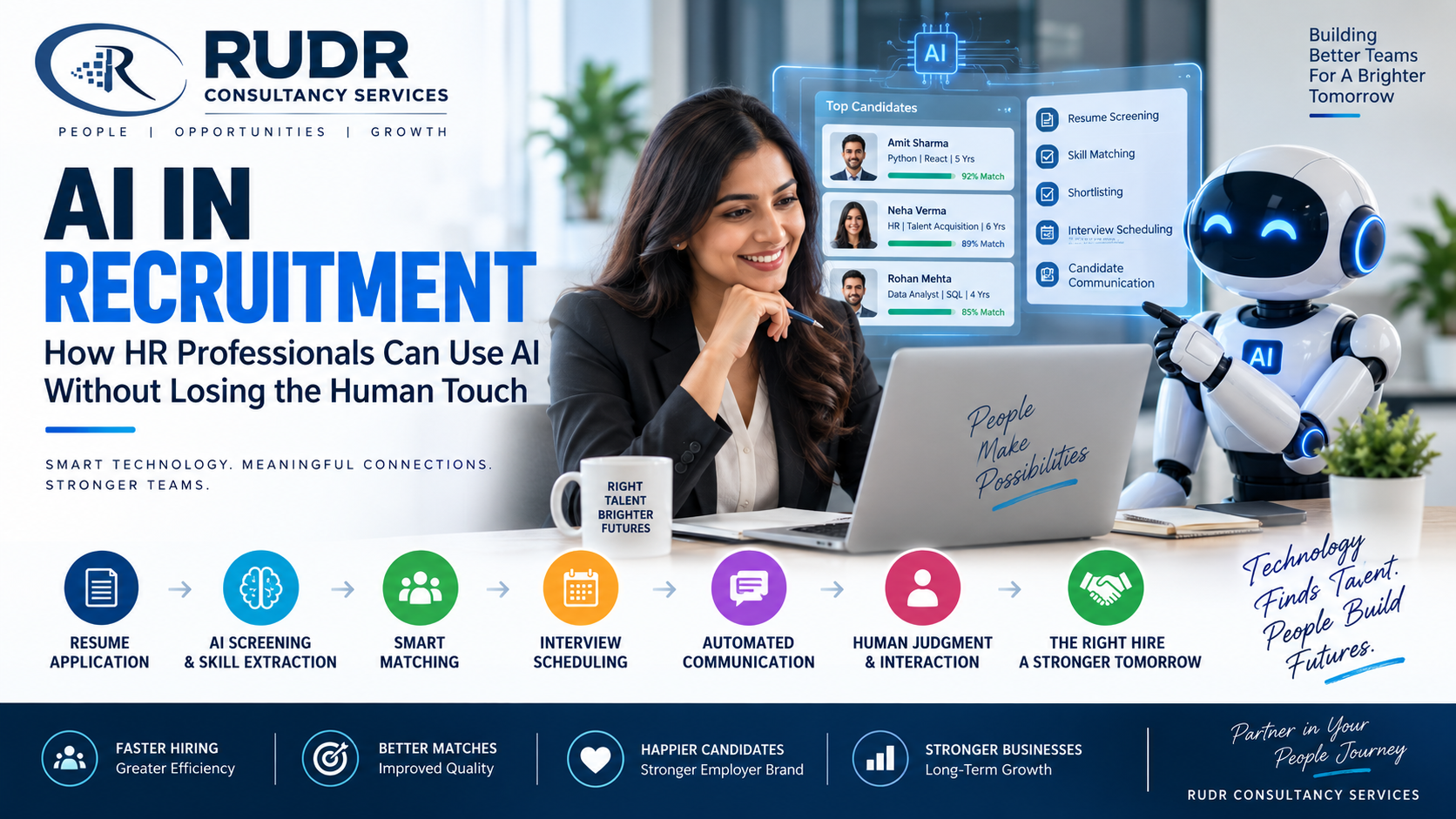
Recruitment has always been about people. A resume may contain a candidate’s experience, qualifications, skills, and achievements, but behind every resume is a person with ambitions, expectations, strengths, and a story. Today, artificial intelligence is changing the way organizations discover and evaluate talent. From screening thousands of resumes to identifying relevant skills and automating candidate communication, AI is becoming an important part of modern recruitment. But as technology becomes more powerful, one question becomes increasingly important for HR professionals: how can organizations use AI to make recruitment better without making it less human?
The Recruitment Process Is Changing
For many organizations, recruitment begins with hundreds or even thousands of applications. Recruiters may spend hours opening resumes, searching for relevant skills, comparing experience, checking qualifications, and identifying candidates who match a particular position. This repetitive work can consume valuable time that recruiters could otherwise spend speaking with candidates, understanding business requirements, and building relationships.
AI can change this equation. Instead of asking recruiters to manually process every application, AI-powered recruitment systems can analyze large volumes of candidate information in a much shorter period. They can identify relevant keywords, recognize skills, organize candidate profiles, compare resumes with job requirements, and help recruiters create a more manageable shortlist.
The real opportunity, however, is not simply to make recruitment faster. The greater opportunity is to give HR professionals more time to focus on the human side of hiring.
AI Can Become a Recruiter's Assistant
The most useful way to think about AI in recruitment is not as a replacement for recruiters, but as a powerful assistant.
Imagine a recruiter receives 2,000 applications for a technology position. Reading every resume manually could take an enormous amount of time. An AI-powered system can process those resumes, extract information such as technical skills and years of experience, organize candidate profiles, and identify potential matches against the requirements of the position.
The recruiter can then review the results, investigate promising candidates, speak with them, and make the final assessment.
This changes the recruiter's role from spending most of the day searching through documents to spending more time understanding people.
From Keywords to Skills
Traditional resume screening often depends heavily on keywords. If a job description asks for Python, React, SQL, or project management experience, recruiters may search for those exact terms. But candidates do not always describe their experience using identical language.
AI can help identify relationships between skills, experience, job titles, and responsibilities. A candidate might not use exactly the same wording as the job description but may still have relevant experience.
For HR professionals, this can create a more comprehensive view of candidate capabilities. Instead of looking only at whether a particular keyword appears on a resume, recruiters can use technology to understand the broader skills and experience represented in a candidate's profile.
Human review remains important because context matters. A system may identify a potential match, but a recruiter must still determine whether the candidate's experience actually fits the role.
AI Can Make Candidate Communication Faster
One of the biggest frustrations candidates experience during recruitment is silence.
A candidate submits a resume and waits. Days pass. Sometimes weeks pass. The candidate does not know whether the application was received, whether the position is still open, or whether another stage of the process is coming.
AI and automation can help HR teams communicate more consistently. Automated systems can acknowledge applications, provide interview reminders, answer common questions, and help candidates understand where they are in the recruitment process.
This does not mean every candidate interaction should be handled by a machine. In fact, important conversations should remain human. AI can handle repetitive communication while recruiters focus on conversations that require empathy, judgment, negotiation, and understanding.
AI Can Help Recruiters Discover Hidden Talent
One of the most interesting possibilities of AI recruitment is the ability to identify candidates who might otherwise be overlooked.
A candidate may have an unusual career path, transferable skills, or experience in another industry that could be valuable for a particular role. A purely traditional screening process may reject that candidate because their profile does not perfectly match a predefined checklist.
AI can help recruiters explore connections between skills and experience that may not be immediately obvious.
For example, someone who has worked in customer support may have developed strong communication, problem-solving, product knowledge, and relationship-management skills that could be relevant to another position. Technology can help surface these possibilities, while the recruiter decides whether the connection is genuinely meaningful.
The Human Touch Cannot Be Automated
Recruitment is not simply a data-matching exercise.
A candidate may have the right qualifications but may not be interested in the organization's work environment. Another candidate may have less experience but demonstrate exceptional potential, motivation, and adaptability. Someone may have an impressive resume but communicate poorly with a team. Another person may have an unconventional background but bring exactly the perspective an organization needs.
These decisions require context.
A machine can process information. A recruiter can have a conversation.
A machine can identify patterns. A recruiter can understand circumstances.
A machine can recommend a candidate. A recruiter can ask the questions that reveal whether the candidate is actually right for the organization.
This is why the future of recruitment should not be about choosing between humans and AI. It should be about combining the strengths of both.
AI Also Brings New Responsibilities
The use of AI in recruitment comes with important responsibilities. HR professionals need to understand how recruitment technologies make recommendations and what information those systems use.
If the underlying data or design creates unfair patterns, an automated system could potentially reproduce or amplify them. This is why organizations should not blindly accept an AI-generated ranking or recommendation.
Human oversight, appropriate validation, transparency, privacy protections, and regular review are important parts of responsible AI adoption.
Technology should support better decisions, not remove accountability from the people making those decisions.
The Future Recruiter Will Be More Strategic
As repetitive recruitment tasks become increasingly automated, the role of HR professionals is likely to become more strategic.
Recruiters will spend less time manually processing information and more time understanding workforce requirements, building talent communities, advising hiring managers, engaging candidates, strengthening employer brands, and creating better recruitment experiences.
The recruiter of the future may therefore look less like a resume processor and more like a talent advisor.
Technology will handle more of the administrative workload, while people will remain responsible for judgment, relationships, communication, and organizational understanding.
AI Should Make Recruitment More Human, Not Less
There is an interesting paradox at the center of AI recruitment. The more effectively technology handles repetitive work, the more time HR professionals can potentially spend doing the work that technology cannot genuinely replace.
A recruiter who no longer has to spend hours sorting resumes can spend that time talking to candidates. A hiring manager who receives better-organized candidate information can spend more time understanding potential. An HR team that automates interview scheduling can spend more time improving candidate experience.
Used thoughtfully, AI does not have to create a colder recruitment process.
It can create space for a warmer one.
The Right Balance Between Technology and People
The strongest recruitment strategy is unlikely to be completely automated or completely manual. It will be a combination of technology and human judgment.
AI can help organizations process information faster, identify potential matches, automate repetitive tasks, and improve recruitment efficiency. HR professionals bring the judgment required to understand people, evaluate context, communicate expectations, and make responsible hiring decisions.
The technology should support the process. The people should remain at the center of it.
Conclusion
Artificial intelligence is changing recruitment, but the fundamental purpose of recruitment has not changed. Organizations still need to find people who can contribute to their goals, grow with their teams, and create meaningful value.
The future of HR will not belong simply to organizations that use the most advanced technology. It will belong to organizations that know how to use technology intelligently while preserving trust, fairness, communication, and human connection.
AI can find patterns in a resume. It can identify skills. It can organize thousands of applications. It can automate conversations and simplify workflows.
But a career decision is more than a data point.
Behind every application is a person. Behind every hiring decision is a team. And behind every successful hire is a relationship.
The best use of AI in recruitment is therefore not to remove the human touch.
It is to give HR professionals more time and better information to use it where it matters most.